McComas’ Myths of Science

This blog responds to and make comments about William McComas’ article titled, “Ten Myths of Science: Reexamining What We Think We Know…”

In case you weren’t aware, that was a nod to the original article (which is linked here).

McComas briefly examines the mainstream role of myths, where they can be entertaining and humorous, and contrasts them with myths surrounding science. He explains that such myths are harmful in the ways in which they blur and block the public’s understanding of reality.

I find this statement compelling in the sense that we should accept hypotheses are most likely wrong, but fear myths. In class we talked about accepting our wrongness, but I also read an article that spoke around this area. A common critique brought up about having false hypotheses or understandings is that we are simply “choosing the answer we already know is wrong”. This, however, is false. We are not choosing something that is wrong, and even if we were we are not simply accepting that something we think is wrong. Rather, we strive to prove ourselves wrong to expand our understanding of what is true. This thinking has also been influenced by the thoughts of Karl Popper surrounding falsifiability, where in order for something to be truly scientific the hypothesis or theory in question must be capable of being proven wrong (therefore capable of being tested).

This contrasts with myths as we are so eager to believe what they state as truth. Not only this, but we spread it (McComas even stated that scientific myths are spread most by science textbooks). Myths somehow manage to become concepts that no one tries to check or disprove. This is where they become so detrimental to our understanding of the world. Like McComas stated, they blur our understanding. Who would’ve thought that such an innocent seeming word could do such harm?

M Y T H O N E: hypotheses become theories which become laws

The danger surrounding this myth lies in the fact that people are more willing to dismiss scientific knowledge due to not understanding the evidence and explanation that surrounds it.

Due to the nature of the word “law” we automatically associate it with the top of a hierarchy. In reality, laws are observations that we generally accept to be true (generalizations, patterns, etc.). Contrarily, theories are collections of knowledge that explain principles. Laws are the whats while theories are the whys.

I have multiple questions surrounding why we think this way.

Similarly to before, I’m intrigued by the fact that we seem to be wired in a way where our brain messes up connotations so much.

I also feel the need to wonder why we seem lenient to accept science. We learn to trust anything scientific. We learn, we admire, and we like to throw out “its a scientific fact” in any argument that we’re losing. However, in certain moments we so easily deny science when it doesn’t align with what we believe (or want to believe). Instead, we say something is “just a theory”.

M Y T H T W O: a hypothesis is an educated guess

This is yet another example of harm coming from our skewing of words and their meanings.

Interestingly enough, the solution that has come up is to throw out the term hypothesis (called an immature theory by Issac Newton).

As McComas wrote, “…the question remains, ‘an educated guess about what?’ The best answer for this question must be, that without a clear view of the context in which the term is used, it is impossible to tell,” I immediately answered.

“An educated guess about why something happens!”

However, I know good and well that I have never come up with a hypothesis that guesses why something happens. Rather, my hypotheses fall more under the category of, “An educated guess about what will happen.”

Whilst reading this I feel troubled pondering the role of science in education. Particularly the science fair and the “scientific method”.

M Y T H T H R E E: a general and universal scientific method exists

I don’t have much to say regarding this myth as it is fairly straightforward.

I’ve already mentioned our beloved “scientific method”, however, McComas contributes a potential cause for our believing that said method is universal. That being that we assumed so from scientific journals.

Understanding that the scientific method isn’t so strict as we’ve been taught allows for such a brighter view of science. Science isn’t perfect and it doesn’t follow some formula. Scientists are not just math geniuses or “book smart”, rather, they’re creative and innovative.

M Y T H F O U R: evidence accumulated carefully will result in sure knowledge

On a broad note we can go back to early TOK discussions regarding whether or not we can be truly sure of anything.

However, this also correlates to what scientific knowledge really is through falsification as well as induction (a topic McComas goes into).

M Y T H F I V E: science and its methods provide absolute proof

In my eyes this honestly falls very similar to myth four.

M Y T H S I X: science is procedural more than creative

M Y T H S E V E N: science and its methods can answer all questions

M Y T H E I G H T : scientists are particularly objective

I’m choosing to group these three together as they all led me down a similar thought process.

With each myth it is apparent that they are concerning due to the belittling they do of science. This connects back to my earlier discussion of myth three. What strikes me even more is the fact that so much of this false information is spread through textbooks and science classes (which was not only stated by McComas, but also something I can say that I have witnessed).

I began the article a bit critical of the author as though he was being a bit dramatic about the severity these myths could cause, however, as I continue I understand. Science being put into a pretty little category is limiting what it is capable of doing and therefore our understanding of the world and potential progressions we could be making.

It may be that I’m sensitive to such treatment of science due to what we’re experiencing with COVID, however, I like to believe that COVID has only broadened my belief in science and opened my eyes to myths.

M Y T H N I N E: experiments are the principal route to scientific knowledge

Yet another myth caused by our failure to understand words!

McComas states that what we believe to be experiments can usually be better described as, “technical procedures, explorations or activities”.

The main thing to gain from recognizing this myth is that scientific knowledge can be gained from many different ways.

M Y T H T E N: all work in science is reviewed to ensure the work is honest

In reality, most scientific work isn’t reviewed due to scientists being busy.

This brings up an interesting conundrum. Is it more valuable to constantly produce more scientific knowledge or to have various scientists reproducing other scientists work to test its validity?

I myself would prefer the first option as we previously recognized the fact that what is produced can’t be sure anyways, so what does reproducing it actually do other than confirming a thought than we can never completely accept as reality?

Overall, I feel as though we need to grow to understand various scientific terms and concepts. This would better our understanding of what science actually is and allow it to grow.

My brain is a bit fried from thinking too hard and failing to write. For all we know, everything I just said could have been the spread of misinformation (also known as a myth). But we can never really be sure.
The Old Lady Walking Club: CAS Blog Thirteen

The Old Lady Walking Club was formed by me and Mrs. Hook earlier this year.

Mrs. Hook was the one who came up with the idea as a way for our entire class to come together. It wasn’t necessarily a club or anything of the sort, but rather a one time occurrence.

I checked to make sure that my schedule was free (which it luckily was!) and then planned to meet up and go on the walk with one of my friends, Mary. We held our excitement and giggles at the thought of going on a walk with our teacher after school for the entire day. Once the school day was over we met up and found out that one of our other classmates was also planning on attending the walk.

We walked around the school campus, making jokes and getting to know each other better (as we had never really talked much until that point). At one point we even went to the parking lot to get some water or needed items from our cars, making sure to share with each other.

At 3:45 pm we were waiting at the staircase for Mrs. Hook to join us. We heard whistling and footsteps, and soon Mr. Brewer joined the group. We waited a bit longer and soon Mrs. Hook came down the stairs. Just as we were starting our walk we were met by another classmate, who went so far to skip practice in order to spend time together.

We started our walk and Mrs. Hook let us know that she would be showing us her special walking path. I was honestly a bit critical at first, but the path certainly ended up different. I assumed we’d start walking on the greenbelt at the elementary school, but instead we crossed the street at the stadium parking lot and walked along the side with the baseball and soccer fields. All of us saw people we knew, and we were able to cheer them on in their various sports.

The entire group laughed and chatted the entire walk. Whilst getting to know each other we were able to enjoy the sunlight and break a light sweat.

At one point we started talking about CAS. Mr. Brewer suddenly got excited as he brought up the idea of making the walk more than a one time thing. It was at that point that the Old Lady Walking Club came to be.

The following weeks we compared schedules and announced to the class when we would be hosting walks. We even came up with our own theme song, “Marsha Hook walking club! Marsha Hook walking club!”

Through the walks and the “club” I’ve learned a lot. I’ve learned about the growth that activities can have for your relationships (this coming from someone who has never really done sports). We learn and cheer for each other, whilst doing something with our bodies (and brain as we work out the various paths).

I love the Old Lady walks and can’t wait for the next one!

Letters: CAS Blog Twelve

I was born a younger sister. My time as the youngest in the family was short lived, as my brother was born one year and nine months after me. That being said, this year is my sister’s senior year in high school.

I’ve had senior friends, but I’ve never actually seen the senior year as close up as this year. There’s still a good bit of the year left, meaning a good bit of the very exciting aspects of the year are still to come.

I say all of this to lead to the topic of senior letters. As one could assume from all that I said earlier, I’ve never written a senior letter. I have considered writing one in the past, but never actually followed through.

I knew that I had to write one this year for my sister, not only because she’s my sister, but also because of the power of words and cards (which I discussed in an earlier CAS blog). However, I’ve learned that the process of making a letter as well as the general energy surrounding a letter is so different than that of a card.

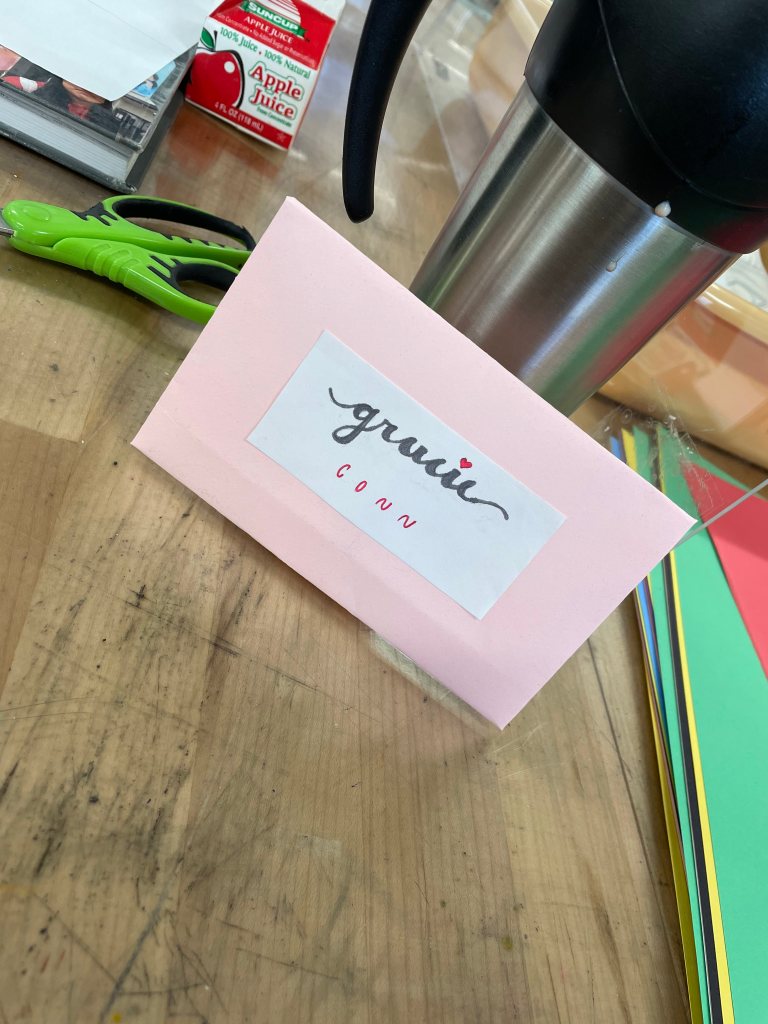
First, I placed more of a significance on the envelope that holds the letter itself. I very easily could of gotten any envelope out of a box (meaning I could have bought one that was premade), but I really wanted this to be personal. Therefore, I decided I’d learn how to make an envelope myself.

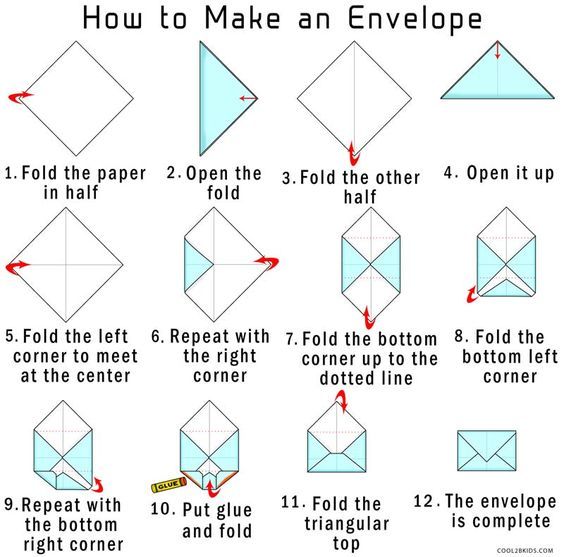
I simply googled the instructions on how to make an envelope. I was surprised just how many different methods existed, so I looked at some of the different results and settled on one (Which I will add at the end of this post if I can find it! I’m choosing to add it later so it doesn’t show as the cover image).

I’ll admit that I underestimated the size of the paper needed for a decently sized envelope, so my envelope was small. Luckily, the paper I chose to use for the letter itself was small and could be easily folded, so the size of the envelope did not prove to be too much of an issue.

After folding the envelope I also cut out a square and made a name card to glue on the top.

I spent a good amount of time on the actual letter. I felt (and still feel) that it was the most important part of the entire product. Obviously I won’t be sharing exactly what I wrote due to the nature of the letter, but I still want to highlight my thoughts on the letter and experience.

I don’t know how my sister will react, but I know that the letter will mean something to her. I know that all of the letters made will mean something to every senior that is graduating. It makes my heart happy knowing that so many people get involved in sharing their words, and I could only wish that people did it more than just this occasion.

I feel as though I’ve grown in a couple ways from this. Not only did I learn how to make an envelope, I also learned to continue to use my words and heart. Even though it doesn’t seem like the best thing to do (and honestly isn’t the best thing in most situations), when it feels like there isn’t anything you can do to help it is important to know that there always is, and it can mean something.

My finished letter

How I made my envelope

IB Ambassadorship: CAS Blog Eleven

I’m hoping this blog is an interesting one as it involves a recent event that all of us were involved in as well as something that I plan on expanding in the future for more CAS projects (even going into my senior year!).

This past Tuesday was the IB meet and greet for the sophomores and potential IB candidates for next year.

Mr. Brewer had talked about this event to us for a bit before it actually occurred in order to ensure that we knew what would happen as well as to encourage some of us to speak about our experiences in the program. As part of the preparations Mr. Brewer also told us that he’d need some ambassadors for the program, explaining that if you became one you could take it as seriously or as light-heartedly as you’d please.

Once prompted I decided to raise my hand to become a candidate. Obviously this wasn’t too big of a deal, but I was interested and decided to go for it. I won’t pretend that there was an intense election or selection process, rather Mr. Brewer put everyone’s names into a random generator and mine just so happened to be selected (along with Zoe, if I had the link to her blog I’d link it, but for now I’m not sure what it is)! At the time all this meant was that I needed to give Mr. Brewer my electronic signature so he could add it to the invitations.

Later at the actual meet and greet I found myself too shy to speak in front of the entire crowd. However, after we moved to the cafeteria I decided to push myself into talking more with the sophomores. Once I found a group I could settle into it was much easier to talk and I was even able to get the sophomores to open up. They started to actually ask questions and soon found answers to questions they didn’t even know that they had.

From this experience I learned to open up a bit, relax, and that communication can clear things up for both parties.

After the meet and greet I spoke to Mr. Brewer one on one about potential CAS opportunities with the title that I now have of “IB Ambassador”. Together we did a bit of brainstorming about events we could hold, such as more meet and greets and potentially some sort of shadow day or interaction that students could have in order to have the capability of seeing what IB is like in an IB classroom.

Obviously I can’t speak for the future, but I’m excited about what I might do with CAS and the opportunities that can arise.

Maths and Solving Problems

The main reason knowledge is produced is to solve problems.

Before truly unpacking the significance and truth of such a statement I believe it is necessary to unpack the statement.

One of the first things that sticks out to me is the mention of knowledge being produced. I already have a post about my learning philosophy, which is intertwined with my idea of what knowledge is, but a brief description would be an understanding that is garnered over time through experience. When thinking about knowledge I always go back to the concept that knowledge is an understanding rather than just memorization.

This is what makes that statement interesting, and almost paradoxical in my eyes. The idea that something that must be earned through life experience or through experimenting due to one’s human nature is “produced” causes one to ponder not only the extent to which they truly understand knowledge but also how this production occurs. This can easily be connected with the discussion of whether information is discovered or invented.

The second significant part of the statement regards solving problems. While this should be straight forward I can’t help but wonder what it means to solve a problem in our world. The idea of solving a problem is easily applicable with math as we generally relate problems to textbook questions and answers. However, this can be questionable itself, as it seems as though the only reason the problem exists is to be solved as if the problem comes from the answer. I also assume that problems can arise due to looking at the world in a scientific method-esk way, where one would have a question and would derive a problem from the said question.

The main reason I dwell on such simple words that are quite common in the English language is because they are so simple. I feel that solving a problem is so black-and-white, where knowledge revolves around an understanding that is full of color.

But really, when looking at the statement in its entirety, how true is it, especially regarding knowledge of mathematics?

I don’t particularly agree with the statement. This, however, contradicts with my previous self, as I have a note from January 20, 2021, that reads, “[Math] is about understanding how we can manipulate numbers or ideas to function in ways that can solve our problems.”

While I generally agree with myself at the beginning of my statement, I fall weary as I begin to talk about using manipulations solely to solve our problems. I feel as though I use knowledge as a portal to help me think and as a way to work my brain. To me, this is why we yearn for knowledge, that is to have an advanced understanding as well as the sense of accomplishment that comes with it. The capability of solving problems simply comes along with understanding.

Throughout our study of mathematics multiple people have stated that they believe math is solely theoretical, a thought that aligns with the statement that knowledge is produced and later used to solve problems (many of which would have been created by humans in the first place under the scenario that math is theoretical). Despite having multiple discussions regarding this I simply can not agree.

I make the assumption that those with this view align under a nominalist mindset, however, such a view really comes across as a fictionalist mindset (Due to the fact that when one states that math is theoretical is seems to be in the sense that math is consisting in theory and generally impractical, as though the concepts and theorems themselves do not truly exist).

Through saying this I paint myself out as a platonist, which I truly wouldn’t say that I am, however, when I see knowledge in the area of mathematics I see beauty and I see the world. This sparks the question of whether or not I see perfection in math. I’m not sure whether or not I see perfection, but I do see qualities that are inhuman, or greater than man to produce, strengthening my faith in knowledge being discovered. When asked about beauty or elegance my first thought was something that is clean, or pure. This leads me to the concept of clean/pure math.

For some, including Max Tegmark (a famed physicist), the world and the way we live revolves around math, and therefore knowledge. Some could come to the conclusion that math is discovered bit by bit whilst it envelopes our world.

While all of my thoughts are a bit jumbled I truly feel as though they all revolve around the statement in a beautiful mess. This leads up to the fact that rather than believing that math is produced to solve our problems, the craziness that is the knowledge garnered in the subject of mathematics is used to understand the world. This could be on a big scale as humankind advances or on a smaller scale of people just trying to learn as their life progresses.

The ability to solve problems that arise during the process that is living is always nice. But overall, I don’t believe our purpose in achieving (note that I prefer the word achieving over the word producing) knowledge throughout a lifetime is just to solve problems. I feel and hope that we live and learn in order to do more.

Collecting Change: CAS Blog Ten

As many of my classmates know, I work at Ingles.

I’ve worked there for a few months at this point and while I have learned a lot it has also proven to be very challenging and tiring. Trying to juggle school generally only allows me four hours of sleep and leaves no time for my personal interests.

While I am definitely capable of rambling about my job it is in no way what this blog is about.

During my shifts I find a lot of loose change. Customers usually drop it, choose to leave it, or forget about it. Normally I wouldn’t think anything of this, but I saw another cashier do something that sparked an interest in this change.

A customer came through her line but realized they didn’t have enough money for what they were buying (I honestly can’t remember what they were buying, but I assume it was some kind of food product). As they were about to leave with their head hanging low my coworker stopped them and pulled out some change from her pocket.

I decided I wanted to help people who need it with all of the loose change that people abandon. I started taking every coin I found, even if it was just a penny. I put all of the coins in the middle pocket of my apron.

I won’t lie and act as if I’m giving large sums to help people who need it, but there have been so many occasions where I’ve had customers trying to buy food or children trying to buy candy that are saddened by the fact that they are so close to being able to complete their purchase but just fall short. Just a small amount of change can make a big difference to someone’s day. I always feel pride and relief in the joy that I can give to someone just by using a few quarters, dimes, nickels, and/or pennies. I’m not sure how to describe their appreciation, but it is definitely prevalent.

While so many of my other CAS projects seem to be a one time experiment I will without a doubt continue to collect any change. It is so easy yet so impactful, and I’ve learned that first hand. Through this I’ve also been left to ponder about the world. I could consider it harsh and cruel for putting people into situations where they need so little but so much at the same time, or I can look at it in a way where in a world where we commonly look for the worst small acts can really mean something and light up someone’s day.

I obviously don’t have any pictures for this blog because I will neither break rules to take pictures at work nor try to take a picture of myself picking up change or paying for someone’s groceries.

Eating Vegetarian Food: CAS Blog Nine

I’ll start by saying that I am not a vegetarian.

I definitely understand the benefits of being a vegetarian to the individual as well as to the environment. I won’t go on a tangent listing all of the details as to why I’m not a vegetarian or use any excuses because there truly isn’t anything stopping me from being a vegetarian. My entire family eats meat, but it isn’t that hard to just not eat meat. I say all of that to say that this blog won’t be me symphasizing for myself and creating excuses as to why I eat meat, but rather an exploration into the life of someone who doesn’t as well as the lifestyle that comes with it.

My friend, Caro (who actually has her own blog!), is a vegetarian and has been for over a year. She’s chosen to cut meat out of her diet for the better of the world and I really admire her for that. She offered to make me some vegetarian meals and I gladly accepted.

When most people think of vegetarians they assume that they either eat solely from Whole Foods (items that are generally expensive and mainly vegetables) or from boujee vegetarian restaurants that only exist in urban areas or that they only eat junk food as there is nothing available to replace meat.

This is obviously not true.

For one of my meals Caro made me vegetarian spaghetti. This was the first true vegetarian meal (meaning the meal either had the meat removed or had a substitute) I’ve ever eaten, so I wasn’t sure what to expect. I assumed that it would feel like there was something missing, but this was not the case at all! The meal had lots of flavor and I hate to say this because it’s overused, but I felt refreshed after eating a meal lacking meat.

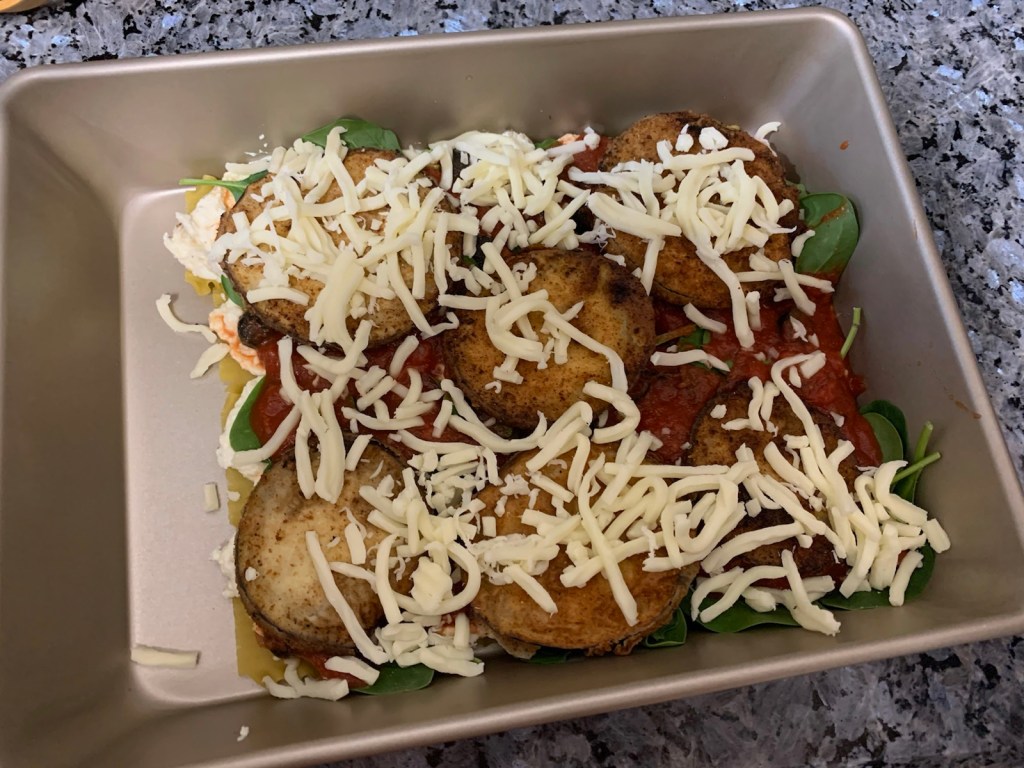
The second meal Caro made (that I actually have a picture of) was vegetarian lasagna. I can admit that I couldn’t guess what it was from seeing what it looked like, but after knowing it made more sense.

The experience with this plate was similar to the one with the vegetarian lasagna. After I was finished I was pleasantly surprised and refreshed.

Overall, I think it is important to go out of your comfort zone sometimes, even if it is just doing something small like trying foods you normally wouldn’t. I learned that vegetarian food can be much better than food with meat, and not just a substitute. It’s interesting to have a peak into the lifestyle of someone else, especially considering that while being vegetarian can be the choice of an individual entirely it can be attached to religions or cultures.

Dog Walking: CAS Blog Eight

With every CAS I try to tackle different parts of the concept (creativity, activity, and service).

While I feel like I’ve been somewhat successful with the creativity and service aspects, there is one area that I know I am lacking in. The thought of activity quite frankly makes me want to punch a wall. I’ve never been gifted in athletics and I find myself embarrassed whenever I try to work out.

However, I know that in order to be truly successful in CAS I must work on my activity. I didn’t want to throw myself in the deep end, so I decided to start with something that I assumed I would like. Therefore, I decided I would spend some more time with my dog and get some exercise by taking him on walks.

Every day (or at least when I could) after school I would take my dog, Bentley, on a walk. Soon it was as if I knew the path by heart. Luckily I was entertained by my music and Bentley never seemed to get tired of walking the same course over and over again.

While this could be tiring or uncomfortable, I knew that it would be good for both Bentley and I. Every time I would come I’d end up sticky, but I also felt good. I know that I feel better when I do more activity, and I hope to continue doing more types of activity, as activity doesn’t have to be boring or embarrassing or straight cardio or weights (though I’m sure that would be nice to work on too, meaning that could potentially be some kind of CAS I do in the future?).

Whilst I’m talking about physical improvement, I want to mention how Bentley has changed too!

When Bentley was a puppy my sister and I decided to take him on a walk together. He got tired very easily and wanted to be carried for a majority of the walk. I always assumed he behaved that way because he was so little (which I do believe is a bit true), but when I first started walking with him he acted in a similar way. He would go as far as he could but would almost always rely on me to carry him at some point. I’ve noticed that the more we walked the longer he could go, and now he doesn’t rely on me to carry him at all! He always takes naps as soon as we get home, but I feel better knowing he’s sleeping because he needs it and not because he’s bored.

Mentally, I do feel a bit happier and accomplished! Admittedly, I never get excited to go on walks and there’s much more I’d rather be doing, but after we go I feel good.

I won’t lie and say that I suddenly love activity because I don’t, but I do feel like there’s some motivation to work on that.

{I want to note that I just got a new phone so some of my blogs won’t include pictures since I lost them in the transfer 😦 }

Painting: CAS Blog Seven

During quarantine I decided to try picking up the hobby of painting. I can’t say that I was able to produce too many pieces of work, but I started to develop a skill that I later abandoned. My biggest disappointment was that I began to paint a basket, but never finished (at the beginning of the school year Mrs. Lawler mentioned finishing things that you started as CAS, meaning this basket may return in the future).

This past holiday season I found myself in a productive state. I had gotten myself my first job. This put me in a position where I knew that I would soon have much less free time, urging me to do something.

I decided to make an art piece.

I wanted said piece to be special, so I started by making a collage. After my collage was complete I painted over it. My work centered around music. This was as my collage came out of a Rolling Stones magazine about the top 50 concerts from the last 50 years while I painted my favorite musician over it.

I was really happy with how my collage came out, but I felt ashamed in my work after painting over it.

Art is interesting in the way that you can create a piece that you can look at and know that you should be proud of yourself, you know that you’ve improved and made something that is valuable (even if you’re not sure how “good” it is). I look at my piece and I know that I should be proud of the techniques I used to make the piece. Even if I don’t love how the painting on top looks I can see that the method in which I blended the colors into an ombre is nice. I can see that I’ve improved my skill, even if it is just a small amount.

I feel as though it is important to highlight how my skill has improved. I really like every collage I make and I feel as though I improve every time, getting me to a level where I can feel happy with my work. For my painting I honestly don’t feel too confident in my ability to paint, but I’ve gotten better. I started at a level where I knew nothing about how to paint and I’ve learned how to do certain techniques.

Just by trying something new I’ve learned how much I love painting. Even if I’m not good at it, I can work to improve and have fun in the process. I find the activity extremely relaxing, and I can find pride in the products I’ve made.

Journaling: CAS Blog Six

It’s hard to believe I’m already on my sixth blog!

A couple of years back (around four) I decided to start journaling. Eventually I ended up giving it up, causing my shelf to be filled with half finished books as well as some that are completely empty.

I decided that I would finally try to restart journaling. I got a journal and started by collecting some scraps and items that have special memories attached to them. This included anything from saved receipts to notes. I then glued them all into my journal. After that, I wrote a bit about my life and what’s occurred since the last time I wrote. I talked about how I was feeling and about the world.

After writing some of my thoughts I feel so much better. It had the same sort of effect as doing a free write (like we did recently in TOK).

I know by keeping a journal I’m not saving the world, but I feel like I’m doing something. Writing has helped me calm my brain and find some sort of inner peace. If I can organize my thoughts and have something physical I can look back on I feel like I’m helping myself in a big way later allowing me to more efficiently help others. Not to mention that encouraging others to journal can have an effect.

Overall, I’m proud of myself for setting time aside to just write. I feel refreshed and excited about what I could do in the future.

I feel like I’ve improved my writing and empathy skills.

While I would like to include some sort of picture, as I do with most of my blogs, I feel as though in this situation there isn’t anything I feel like I can add. My entries are my personal thoughts, so I’d rather not show them, and taking a picture of the cover of my journal is just a bit more work than I feel like doing. If you’re curious though, my journal is baby blue with white dots.

Design a site like this with WordPress.com
Get started