Understanding the Bad: Murder on Our Minds

Have you ever fantasized about killing someone? Or even said the phrase, “I’m gonna kill them”?

In their podcast “The Bad Show”, Radiolab offers solid evidence to prove the somewhat dark nature of humans in an attempt to define what it means to be a “bad person”. The podcast reports that 91% of men and 84% of women have fantasized about killing someone. 75-80% of those who admit this went into vivid detail of these desires.

They remind us of an experiment conducted by Stanley Milgram. In such experiment, Milgram asked research participants to shock people taking a test when they answered questions incorrectly. Have it be known that the people being shocked were just actors and were just faking pain from shocks that never occurred. 65% of the shockers went to the highest pain level. This experiment was repeated multiple times with varying factors. There were only two tests that had an obedience rate of zero. One of which was where two participants were in the room who disagreed with each other and the other was when participants were prodded, “You must continue.” Radiolab insists that humans are willing to shock and hurt others, but when they are told it is an order they don’t want to do it.

According to Radiolab, “…the idea is that people will do bad if they think it’s good, if it’s a good noble cause.” The essence of their argument is that when convince ourselves something we are doing, even if it is something we know is bad, like hurting others, is for a purpose we believe is good we excuse our actions. Radiolab goes on to support this statement by using other stories. This includes the story of Fritz Haber, who used nitrogen as an extremely dangerous weapon during World War I, and the Shakespeare tragedy Titus Andronicus, which is much too complex to describe in few words. Nonetheless, in each example provided someone is behaving immorally, but for a cause that can be interpreted as “good”. Due to this, Radiolab observes that we feel obligated to pardon the wrong-doer.

Radiolab surely is right about our instincts to forgive depending on the scenario, because as they may or may not be aware, hybristophilia (the attraction to criminals) is assumed to be caused by a feeling of forgiving or excusing crimes. I’ve performed extensive research on the topic of hybristophilia as well as the reasons behind the occurrence of it, and a huge theory directly relates to the topic discussed in the podcast.

There’s no way of being 100% sure why hyrbristophilia occurs, therefore there are many guesses as to why it does. Some relate to biology in that women prefer “alpha males”, others address desires to “fix” criminals, while a portion of them assume that fans victimize their lovers. Radiolab shows enough evidence that proves their argument of the pits of human nature while also bringing up an extremely valid possible cause for hybristophilia. The different cases discussed in the podcast even line up with the varying history of the obsessions formed around criminals.

The podcast is even eye opening for those who don’t fall under the hybristophiliac category, meaning most people. I’m pretty positive that everyone out there has either entertained themselves with the thought of doing wrong, out of anger or in an attempt to be darkly comedic, or at least know someone else who has. On the same note, most people have probably either forgiven someone for doing something horrible, or they know someone who has. The truth is Radiolab has opened a door to explore one of the more irking sides of human nature we usually choose to look past.
Bothersome Flashing Lights: The Work of Paparazzi

Just imagine being a celebrity.

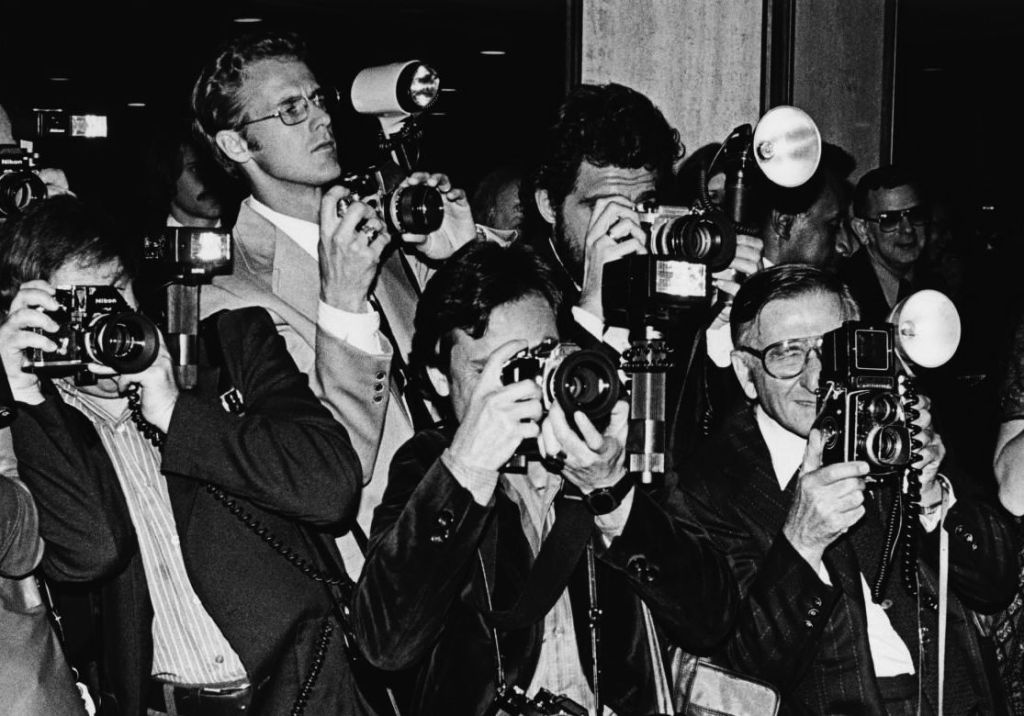
Everyone knows who you are. You can throw around money as fast as you can in Monopoly. You’re constantly put under pressure to please the public, and if you’re unsuccessful in doing so your entire career can end in hours. There’s always someone watching you. People constantly take pictures of you without your consent and spread them so everyone can see. Sometimes, your failure and humiliation can mean their success.

What a life!

According to Select USA (which is part of the U.S. Department of Commerce’s International Trade Administration) the U.S. media and entertainment industry is valued at 717 billion dollars. It makes up for a third of the global industry.

Needless to say, the United States the entertainment industry is excessively influential. Those who are fans are wholeheartedly obsessed, leading to an excess of paparazzi companies. These companies profit from exploiting the lives of celebrities, and they make quite a lot of money.

However, across the water is a country that seems to defy our standard. The country has made over 83 billion dollars in recent years due to a humongous growth in the global popularity of its pop culture. Radiolab tackles the peculiar case of South Korea’s fan culture and paparazzi in the episode “Kpoparazzi.”

The episode begins by defining the relationship between fans and idols. The term idol is a tale-tell sign on its own. It is used as a substitute for the word celebrity, but the connotation is still so different. The stars are expected to be perfect in every way. They are the embodiments of fans’ fantasies. They belong to the public and the fans. They are idols. Radiolab wonders about what the fans want to see. If the idols fit into the perfect illusion, “…do you want to know everything? Or do you want to know nothing?”

This on its own sparks a question of what an appropriate relationship between a celebrity and their fans looks like, as well as what it means to be a celebrity. Our common sense leads us to believe that it is impossible to belong to your fans, but if they are the foundation of your career should you be obliged to please them in every way?

However, that’s just the tip of the iceberg.

In general, South Korea has had censored media after the Korean War. The government felt the need to conceal potentially controversial news surrounding topics such as politics leading to the censorship of almost everything (including celebrity gossip).

A man named Lee Myung Joo came into the picture and changed everything. Lee believed in independent press and was dying for a way to get closer to it. At the time (2010) he was working for Sport Seoul, and he decided to take influence from western news sites such as TMZ and The Sun. For thirty days Lee practically stalked two of the largest stars at the time, Jonghyun from the kpop group Shinee and actress Shin Se Kyung, before the day he calls “Dating day,” or “D-day.”

The first paparazzi photos in Korea were released in October of 2010, and there was public outrage. Soon after news groups focused on the lives of celebrities began popping up, Dispatch being one of the most notable. For two years idols were outed so often that the fans who were originally so shook up became desensitized. Idols were able to share more of their personal lives with less consequences.

Does this mean the paparazzi, known to be a burden, known to use personal details of other people’s lives for money, known to stalk, actually served as liberators of sorts? The tabloids found a way to become what could be considered the great equalizer, the connection between artists and their followers.

It just seems so immoral. It’s impossible to believe that exposing someone’s most private details can create a level of comfort. Yet, because the paparazzi showed the normality of celebrities so often it happened. Paparazzi continue to get shamed for their job, but when they do their job the right way they find a way to comfort fans by showing the fans the last thing they would want to see. Or this all could be so different from what would be expected due to an extreme cultural barrier. They took techniques from the west to use in a country where pop culture is so different.

Nevertheless, in the end we can’t help but strong emotions against paparazzi after remembering the extreme behaviors so many present. Next time you see paparazzi photos, look at the celebrity. Try to feel what they feel, discover what they’re thinking. Ponder whether or not they actually paid for staged photos. Examine what effect the paparazzi may have.

The Human Race and the Fear of Death

Tick tock

The time in which we live on Earth is limited. We learn, we work, we change, we do everything we can to secure we live life to the fullest. We do all of this and so much more before the biggest event of our life.

Tick tock

Death.

Just writing that inflicted a feeling of anxiety inside me, and I assume reading it would do something similar to you. Death is a topic that is hugely avoided in conversation, which may seem obvious as inflicts a feeling of depression in most people, but it is one of the most important parts of life.

Our fear of death and the effects it has on us is discussed in depth in Hidden Brain’s September 26, 2019 episode, “Death And The Great Beyond: How We Grapple With The Idea Of Dying.”

Sheldon Solomon introduces himself on the show to bring his Terror Management Theory into light. Solomon explains the concept; the fear of death drives a range of human responses without anyone realizing it, our strong mental defenses ensure this. For example, Solomon conducted an experiment with a group of judges. They were presented with a hypothetical situation of a prostitute caught in court and were asked what bail amount they would give. The control group gave an average bail of $50. The group that was reminded of their mortality, gave a higher bail of $455.

Death is a part of our culture. When a sensitive area of our culture is touched on, especially an area we choose to completely avoid, we feel the need to retaliate. This is shown at an extreme level with the judges. After being forced to think about our mortality a bail nine times higher than the average bail for the offense was given.

Truthfully, our existential anxieties are not due to the fear of death, but the fear of the thought of death. We are able to imagine dying, but we are incapable of imaging being dead. This concept is referred to as the mortality paradox.

There are four immortality narratives: rejuvenation, resurrection, reincarnation, and the search for fame. The soul, which is a massive reassurance for many, finds itself under some of the narratives. The belief of a soul spans across the world, 71% of Americans believe, around 60% of the British and Germans believe, 90% of Indians believe, and about 100% of Nigerians believe.

There are two problems that can be found with every narrative. First, we seek immortality, but we don’t know what to do with it. We hate the idea of dying so much, but we don’t want to live forever. There comes a point where dying is a reality, and that isn’t so scary. What’s tear-jerking is the thought of something so out of our hands coming when we don’t know.

Another problem is that we see death as a problem that needs to be solved. Death isn’t necessarily a problem, it’s a part of life. And even if death was a problem, we can’t solve it, we can’t do anything to change it or fix our fate. It’s inevitable.

In Hidden Brain, the podcast was concluded around a quote from the Greek philosopher Epicurus, “When I am here, death is not. When death is here, I am not. Therefore, I don’t have to worry about dying.” With this statement Epicurus is attempting to reassure everyone of death while also admitting the fear exists. He took a surprising stance of drawing a thick line between the state of being alive and dead, a line most try to dance around, such as those who strongly believe in a soul.

We’re going to die. It’s a part of life, a part of a never-ending cycle. Despite death being something so normal, we’ve made it something so abnormal, so unspeakable. Yet it has this power over us, to change the way we think and act.

So, what is death? What happens when we die? Let’s talk about it.

All About Perspective

Why does it never stop?

“It? What is it?”

Thanks for asking. I’m referring to the never-ending cycle of schoolwork. Every student has to be aware of it by this point, even though some students genuinely don’t care. Every day I come home from school with some form of an assignment, and every weekend (any holiday from school, really) I find myself complaining about some large burden that has been piled onto my shoulders that I have to complete. Even during summer, after I have completed a course and gotten my hopes up of never having to worry about anything related to that subject whatsoever, there’s something given that the next teacher will surely check.

“I guess it doesn’t stop.”

That’s what it feels like, or at least that’s what I tell myself to make myself seem jolly about the world I’m so blessed to live in (hopefully you take notice of my sarcasm that is a part of my very charming sense of humor).

Mr. David Foster Wallace would most definitely be disappointed in me. Wallace is the author of, “This is Water,” which was originally a commencement speech given at Kenyon College in 2005. The speech decides to go in a different direction than most commencement speeches would, Wallace chooses to be realistic to the graduating students as he explains the downfalls you can face if you don’t take control of your perspective of life. Personally, I strongly believe the description he uses throughout the speech makes it relatable for everyone.

(If reading a speech isn’t your forte, there are numerous videos using the actual audio from when the speech was given. Sometimes, this can enhance your experience of the speech, and bring the visuals alive!)

After years of complaining about schoolwork, I realize, I make the choice to complain about the work I signed up for. Complaining is something we all do, almost as if our brains want to pity ourselves. Wallace brings that point up, we almost always instinctively choose the feel the worst.

Wallace suggests, “…if I don’t make a conscious decision about how to think and what to pay attention to, I’m going to be pissed and miserable every time I have to food-shop, because my natural default-setting is the certainty that situations like this are really all about me…” It’s pretty easy to turn this statement into a formula for most situations. As an example, I could say, “If I think the way I automatically want to, I’m going to be annoyed every time I have a new assignment to complete.”

Changing my perspective on assignments can change the entire situation. If we look at the situation as Wallace does at the supermarket in “This is Water,” then we should think about the teachers and other students. Maybe the other students don’t have the best life at home or they are not able to do the assignment at all, but they act as though they don’t care as a defense mechanism. And maybe the teachers hate their lives, yet they do whatever they feel will truly help students get to where they want to be in life.

Obviously assuming this is bizarre, but isn’t that the point? Changing the way you look at the situation doesn’t solve a solution in some magical way, I don’t suddenly love doing my work because I guilt myself into thinking that I should, but that isn’t what changing perspective is trying to make happen. When you try to observe scenarios with a different mindset, possibilities that wouldn’t have been possible open up.

Thank you, David Foster Wallace.

Welcome to the World of Blogging

My name is Emily.

“Wow, what a cool thing to say.” Thank you, I know.

My full name is Emily Rose Conn. I’m in high school at this point of time and creating this blog has become one of my assignments. I can’t say this is my weirdest assignment, though it is hard to beat a dog named Gordon Ramsey or my many rap songs. I think a lack of context make both of those ideas better.

Honestly, I don’t know what I’m supposed to write about here, should I talk about myself and everything I’m interested in, or leave it all to unravel as I post? Maybe I should describe my current situation in case I ever want to look back at this and cringe?

I’m currently sitting in my bedroom, wearing sweatpants and a t-shirt while sporting two buns, something I haven’t done in a long time due to being called “Princess Leia” by someone in my class (I wasn’t hurt by the insult, rather I was annoyed that someone who wore the same sweatshirt everyday tried to come for my fashion sense). I have many BTS posters on my wall and lots of knick knacks around my desk, I am not a hoarder, but it is an obsession. I have a Christmas tree still up in my room and it is pouring rain outside. Oh, I also have a sticky note next to me annoying me with all of the things I have to do. The list includes finishing my first aid book for my HOSA state leadership qualification test next week as well as finishing my summer reading. It’s January. And I have summer reading.

That’s enough of a blabble about myself, but I think I was right in going with that method? From that you can tell my amazing comedy, my aspirations, and what an amazing student I am!

Like I’ve already said, it’s raining cats and dogs, so much so that my Christmas tree is flickering next to me. I’ll wrap this up so I don’t lose everything if the power was to go out.

Thank you for reading this. That’s not necessarily for anyone, the audience could just be an older Emily. Maybe Mr. Brewer will have seen that I’ve written this and gone back to read it. I’ll hope not, because that’s kinda embarrassing for me. That’s a funny thought, I’m allowing this to go on the internet, but cringe at the thought of my own literature teacher reading it.

Until my first assignment.

Emily

Design a site like this with WordPress.com
Get started